Healey says surprise UK growth is 'sign of resilience' ahead of Budget
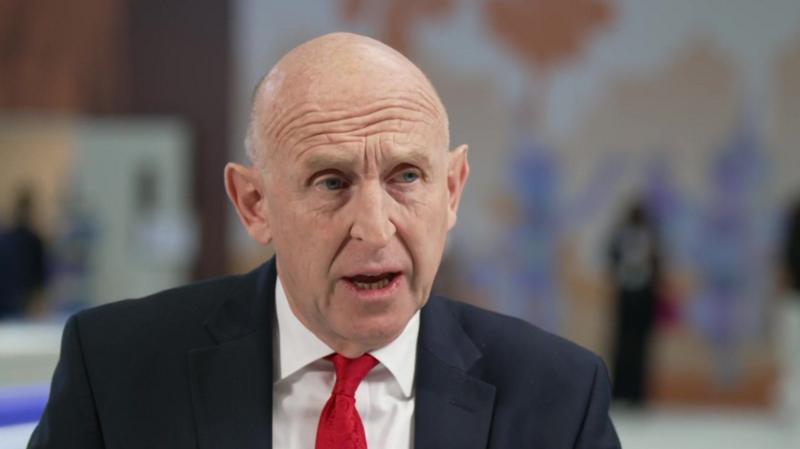
The UK economy's stronger than expected performance in August has been called a "sign of resilience" by Chancellor John Healey.
Healey told the BBC "it's really tough in the face of these economic global shocks" as the latest official figures showed the economy grew by 0.1% for the month, defying analysts' forecasts of a slight contraction.
It follows an upgrade to this year's forecast for the UK economy from global watchdog the International Monetary Fund (IMF) earlier this week.
Mr Healey said he wanted "to give people a bit of breathing space from the cost of living and cost of business pressures", promising to do so when he delivers his first Budget in two weeks' time.
Healey did not elaborate on what measures he will take in the Budget, but promised "where we can take action, we will".
But, vowing to keep up the government's approach to fiscal discipline, Healey said "where we want to do things we have to make sure we can pay for them within the Budget that we've got and control spending".
The latest figures from the Office for National Statistics showed the economy grew by 0.7% in the three months to August.
"It's a sign of resilience in the UK economy that some had not expected," Healey said.
The chancellor said the growth was "part of the discipline the IMF here in Bangkok this week has endorsed that they see in Britain".
Britain's economy was boosted in August by an increase in production, which includes manufacturing, oil and gas extraction and energy supply.
The services industry, which makes up the largest chunk of the UK's economy, was flat during the month, while the construction sector contracted.
Over the three months to August, the UK's economy grew by 0.7% overall. ONS director of economic statistics Liz McKeown said computer programming had been the biggest contributor to what she described as "robust" growth over the period.
But she said the production and construction sectors shrank over the three-month period.
August's surprise expansion follows growth of 0.4% in July. The ONS also upgraded its estimate for June's monthly growth to 0.4% from 0.3%.
Paul Dales, chief UK economist at Capital Economics, said Britain's economy was "more robust than we thought".
He warned that an expected increase in inflation would still "dampen growth", but added that the economy was showing "remarkable resilience to higher energy prices and borrowing costs".
PwC senior economist Jake Finney said the development of AI infrastructure was underpinning Britain's relatively strong performance.
"The UK still lags the US in both the scale of that investment and the boost it provides to growth, but it is making progress and remains ahead of many of its European peers," he added.
What's happening to the UK economy and how does it affect you?
Healey told the BBC the "impact of AI on the economy, on productivity, is only just beginning to register".
He said the technology has "huge potential, as well as huge risks", adding that Britain's priority would be to ensure AI can be developed safely while unlocking the opportunities it presents.
The latest growth figures were released after Healey landed in Bangkok for the annual meeting of the International Monetary Fund (IMF).
Earlier this week, the global financial watchdog praised the UK's plans to cut debt levels, with global borrowing costs on the rise, with managing director Kristalina Georgieva adding that the country was seeing "a bit of a better growth prospect" than other G7 nations.
Healey said: "Despite conflicts in the Middle East and Europe hitting people across the world, today's figures offer more proof of Britain's resilience in the face of these global shocks."
The Conservatives said the economic growth figures "conceal worrying trends in key sectors as we approach a crucial Budget".
Shadow chancellor Andrew Griffith said: "Construction has now shrunk for four months in a row, with private housebuilding falling fastest. Labour promised to get Britain building, but they are failing."
He called for Healey to cut taxes and reduce red tape.
Liberal Democrat Treasury spokesperson, Daisy Cooper, said the growth of 0.1% in August was "nothing to celebrate".
"The economy is stuck in first gear and barely crawling forward, while families are still struggling to make ends meet."
Healey went on to say the Budget would be tough and not include inflation top-ups for public sector pay.
Some experts and unions have called for extra cash for some departmental budgets, to account for the rising costs of providing public services and pay.
But, asked whether there would be extra money made available for nurses and doctors, the chancellor said: "People recognise these times that are tough for everyone, and what they do expect of a government is to manage with the budgets we've got, deliver the public services they need, and that's the challenge.
"Our departments have their spending, and the prime minister and I, being in lockstep about this, where we want to do things, we have to make sure that we can pay for them within the budgets that we've got and control spending."
Source: BBC News. Summary reproduced for informational purposes.
Related
 Economy
‘No indications’ PHP code flaw has led to government systems being hacked, cyber security official says – as it happened
Some 32 government services are offline while work is carried out to address potential cybersecurity issues, a minister has said Tell us: have you been affected by the PHP code flaw? The Office for National Statistics has also published a report on the gender
 Economy
Too little, too late: Trump takes on gas prices as fuel costs hamper his midterm hopes
Polls show US voters are deeply upset by high gas prices and are likely to punish Republicans in the midterms as a result How will Trump’s mass deportation agenda shape the US midterm elections? Our reporters answer your questions With fewer than two weeks unt
 Economy
French borrowing costs overtake US amid budget turmoil
France’s bond market hit by another bout of selling as country recovers from weekend protests French borrowing costs continued to rise on Thursday, as investors fret that France’s government is struggling to pass a federal budget after public protests gripped
 Economy
How much money does the UK government borrow, and why does it matter?
The UK government borrows to fund day-to-day spending as well as long-term infrastructure projects.
Never miss a headline
The biggest stories in business and finance, delivered to your inbox. Join thousands of readers — unsubscribe any time.