Fed has 'work to do' if price rises don't ease for Americans, Warsh says
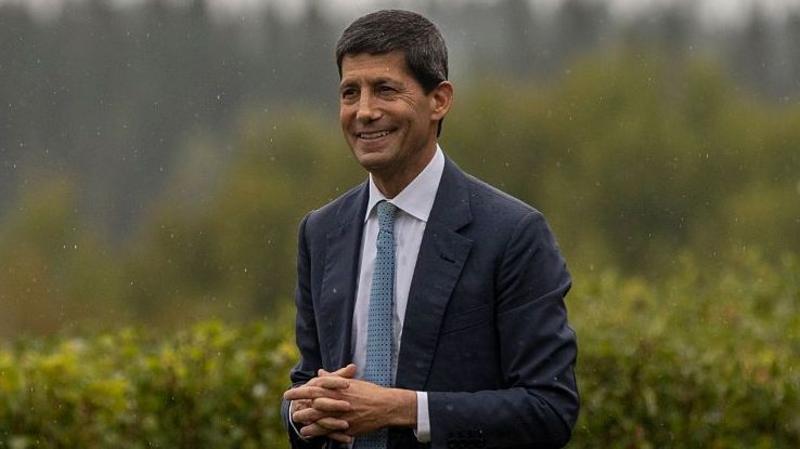
The head of the US central bank has said policymakers will "have work to do" if they were not confident cost-of-living pressures were easing for Americans.
Federal Reserve chair Kevin Warsh said while inflation readings looked better than expected over the summer, they did not show that the current picture had "meaningfully improved".
The new Fed boss stressed that his remarks should not be treated as a guide for future interest rate decisions, but the comments are a signal rates could be raised if policymakers believe inflation is too high.
Latest figures show prices rose 3.4% in the year to July, above the Fed's 2% target. Another inflation measure closely watched by the Fed is running at 3.7%.
Warsh made the comments in his first speech at the annual Jackson Hole Economic Policy Symposium in Wyoming, which sees central bankers, government officials and academics from around the world gather to talk about interest rates, inflation and other economic issues.
Warsh said given prices were rising by more than 2% on an annual basis, "the Fed's predominant focus right now should be on prices".
"Here is my standard: We must be confident that underlying inflation is moving to our objective, clearly and at sufficient speed. Otherwise, we have work to do."
The central bank boss has remained tight-lipped about the potential path of interest rates, but investors will have watched his speech closely for any signs of the Fed's approach under his leadership.
The central bank's next interest rate decision will be made on 15-16 September.
The reactions to any decision made by US President Donald Trump will be closely watched, with the mid-term elections looming and voters concerned about affordability.
Trump, who appointed Warsh in May, repeatedly criticised and pushed his predecessor Jerome Powell to cut interest rates. The president has previously said rate hikes "just keeps the country down".
Warsh issued a plea in his speech to not label his remark as "forward guidance" and said he believed the practice of sending signals to the markets on future interest rate decisions, adopted in the wake of the 2008 financial crisis, had "overstayed its welcome".
"Oversharing policy deliberations and overcommitting to future decisions can lead markets, businesses, and households astray," he said, adding it also inhibited the Fed the "freedom to make the right calls when it's time to decide".
Interest rates were left unchanged between 3.5% and 3.75% in July for the fifth time in a row amid concerns over inflation due to the ongoing conflict between the US and Iran, which has caused as surge in global oil prices.
Following Warsh's remarks, the rates market showed growing expectations of an interest rate rise in September, according to CME data.
Analysts at Capital Economics said Warsh's speech delivered a "far clearer - and hawkish - message" and that it left "the door open to a hike" earlier than previously expected.
"Hikes are not guaranteed, but Warsh is now at least suggesting he is on board with them if economic growth remains strong and monthly core PCE [Personal Consumption Expenditures] price growth remains a bit too firm," they said.
'No magic wand' to tackle high prices, Fed boss says as US interest rates held
Higher oil prices has also fuelled bond market investors, who have demanded higher returns, leading to higher borrowing costs for the US government and other major corporations.
Such borrowing costs impact the cost of borrowing for mortgages, car loans and credit cards.
The spike in interest payments has driven US national debt past the $40tn (£29.5tn). The figure has doubled in a decade under both the Trump and Joe Biden administrations.
The figure is rising by about $90,000 (£66,500) every second, or $7.8bn a day, according to the Congress Joint Economic Committee.
Treasury Secretary Scott Bessent said the government would buy back more debt in a bid to lower borrowing costs, but the market's reaction to the announcement proved short lived.
Interest rate hikes are a tool used by central banks aiming to slow the pace prices are rising in the shops. By pushing up the cost of borrowing for things such as mortgages, loans and credit cards, central bankers hope consumers will spend less and the rate of price increases will slow.
Higher interest rates, however, can lead to better returns for savers.
Source: BBC News. Summary reproduced for informational purposes.
Related
 Economy
Why are European countries moving their gold out of North America?
The Netherlands has relocated 86 tonnes of the shiny stuff - what's going on?
 Economy
Rich people more likely to steal children’s sweets, finds Ig Nobel prize-winning study
We round up this year’s winners at awards for achievements that ‘first make people laugh and then make them think’ It’s that time of year again: a select group of scientists have been summoned to a ceremony to receive coveted prizes, be showered in paper plane
 Economy
Yen soars as Bank of Japan tipped to raise interest rates
Jump lifts currency to highest level against dollar in a month, while global markets remain jittery Business live – latest updates The Japanese yen has soared by more than 2% against the dollar amid speculation the Bank of Japan is set to raise interest rates.
 Economy
NI employers named for not paying staff minimum wage
Across the UK, more than 600 employers were ordered to pay affected workers the outstanding wages, with £4m returned to workers.
Never miss a headline
The biggest stories in business and finance, delivered to your inbox. Join thousands of readers — unsubscribe any time.