Dairy focus: A look inside the gates of Shinagh dairy farm
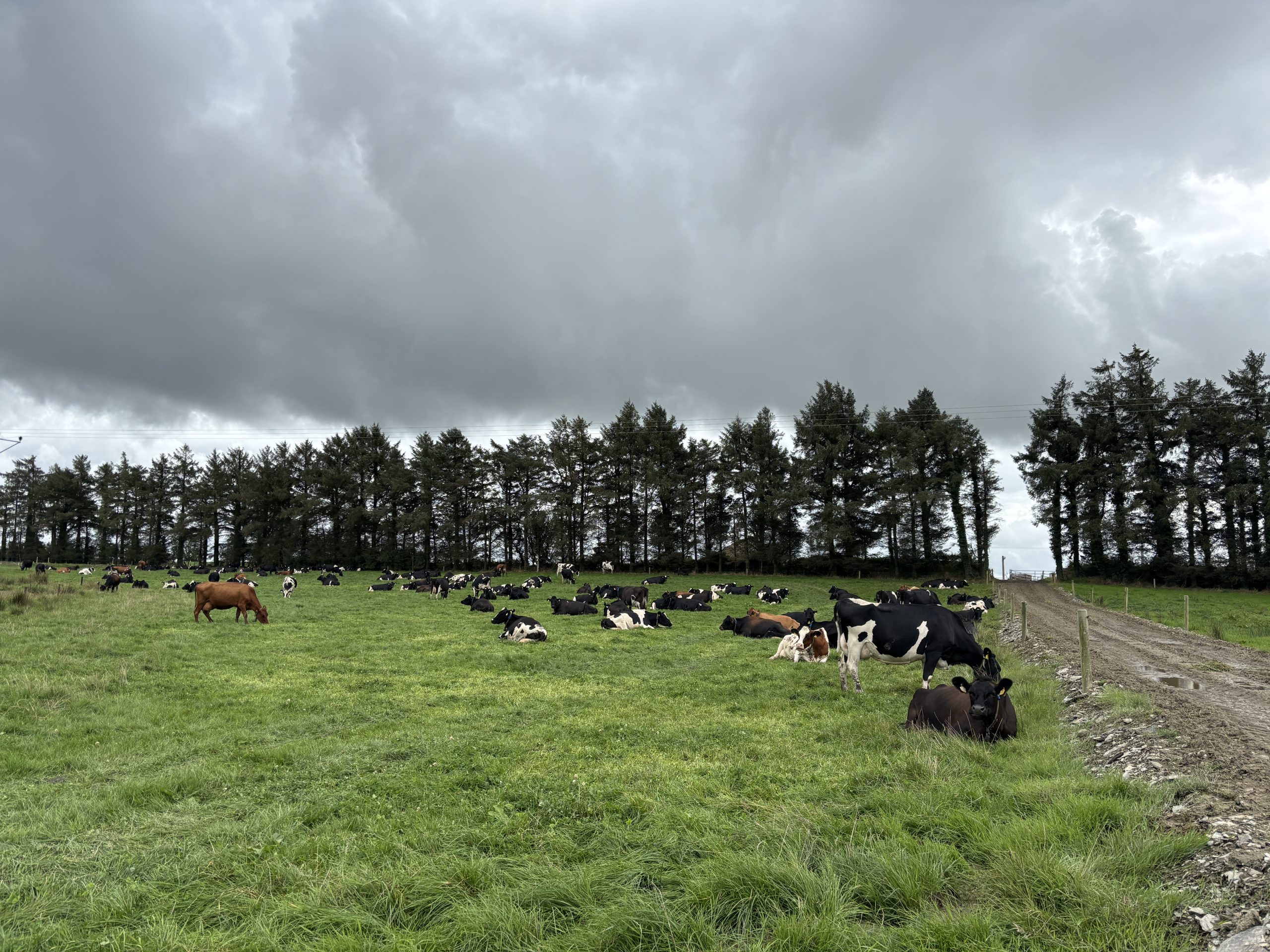
Shinagh Dairy Farm recently celebrated its fifteenth year of operation, welcoming farmers from across west Co. Cork and further afield to view its internal operations.
The farm, owned by Shinagh Estates, was originally an artificial insemination (AI) station where the progeny of AI bulls were fattened.
However, when the 2008 EU Common Agricultural Policy (CAP) signalled the removal of milk quotas, Ireland began to prepare by easing butterfat quotas, with some of the national quota being allocated to Teagasc.
Teagasc then decided to approach Shinagh Estate to see if it would be interested in a beef to dairy conversion.
By 2010, Shinagh Estate had officially collaborated with Teagasc and Carbery to begin its path to dairy.
Shinagh Dairy Farm
The 78ha farm began milking In spring of 2011, following the calving of 200 heifers sourced by Teagasc’s James O’Loughlin.
The 200 heifers consisted of 50% Holstein and pure Friesians, 25% Jersey crosses, and 25% Norwegian Red crosses.
The farm had increased to a 102ha block by 2019, and was milking 250 cows by 2025 under the supervision of farm manager, Kevin Ahern.
The Shinagh herd is currently comprised of 22% Jerseys and 78% Holstein/Friesians.
Currently, the herd is producing an average of 1.40kg of milk solids (MS)/cow with fat sitting at 5.14% and protein at 3.85%, off 3kg of a 12% dairy nut, 6kg of fresh grass, and 9kg of zero grazed grass.
In 2025, the herd produced an average of 459kg MS/cow while stocked at 2.54 livestock units (LU)/ha, with 2.2t/ha of feed purchased in.
The farm has always bred cows with the Economic Breeding Index (EBI) in mind, as Teagasc states every €1 EBI delivers €2 extra profit.
As it stands, the herd now consists of 22% Jerseys and 78% Holstein/Friesians, with its combined average EBI sitting at €181, broken into a milk sub-index of €41, and a fertility sub-index of €81.
The herd is milked through a 20-unit Fullwood herringbone parlour situated in the centre of the farm to minimise walking
The farm’s beef slatted house was converted to a cubicle house for the dairy herd
Drafting systems and collars have been fitted to increase breeding efficiency
In 2025, the herd maintained an 89% six-week calving rate and a 4% empty rate, highlighting the work being put into breeding as well as the impact of heat detection collars.
Grassland and sustainability
From its establishment in 2011 up until 2019, the farm’s main focus was delivering as much profit as possible through breeding strategies, grassland management, and strict cash flow management.
Then in 2020, the farm moved towards adapting sustainable and environmentally friendly practices, which would not affect profitability, hence why the farm is known as Farm Zero C .
A big part of environmental farming falls back on grassland management, so the Shinagh farm set out to reduce its reliance on chemical fertiliser while maintaining grassland production.
By 2025, nearly every paddock on the farm had some bit of clover incorporated in it, with just shy of 60% of all the paddocks having a 20% clover content rate, a sweet spot which allows the farm pull back on chemical nitrogen.
Nearly every paddock on the farm had some bit of clover incorporated
To succeed with clover, the farm needs soil fertility to be excellent, which it has achieved as 60% of the farm is now in optimal conditions across pH, phosphorus (P), and potassium (K).
That is a strong on-farm figure, considering that the national average of optimal paddocks sits in or around 20-25%.
Ahern noted that they react to soil tests quickly, a practice which they carry out every two years.
For example, if a paddock needs a tonne of lime, they will go in with the tonne rather than waiting for it to need 2t.
They then spread K and sulphur alongside any N, while their P allowance is targeted on high ground which does not receive slurry.
10% of the farm is reseeded every year, with white clover constantly incorporated.
Seven years ago, t
Source: Agriland. Summary reproduced for informational purposes.
Related
 Agriculture
Carlow farming family turns GAA medals into business success
The accumulation of lots of hurling and Gaelic football medals by her husband led Ana Coady to start a new business, Little and Loveable, on the family farm. She said: “My husband, John, is a full-time sheep and dry cattle farmer and the idea actually started
 Agriculture
Generators for farms: What support is available?
As the winter months approach, farmers may be considering purchasing a generator. Generators can be vital equipment for farms to have due to weather-related impacts on electricity supply. Farmers may be considering either a diesel generator or a power-take-off
 Agriculture
Rethinking dry-off on a high-performing Kerry herd
For Co. Kerry dairy farmer Maurice Harty, getting the most from a high-performing cow starts with making the most of the genetics in the herd. At Ballylongane Pedigree Holstein Friesians, the Harty family has been breeding pedigree cows since 1967, with the he
 Agriculture
Weekly factory cattle supply up 5,600 head on same week last year
Weekly factory cattle supplies are up 5,600 head on the same week of last year, despite the overall kill this year being down by over 46,000 head or 4.2%. Last year saw unusually lower kill numbers throughout the second half of the year, whereas this year, kil
Never miss a headline
The biggest stories in business and finance, delivered to your inbox. Join thousands of readers — unsubscribe any time.